
Blog
Watchfire ColorLock: A Better Display Begins with Better Calibration
September 11, 2026
Have you ever put on a pair of black socks, only to step into better light and realize one of them was actually blue?
Color can be surprisingly difficult to judge. What looks correct in one environment may appear completely different when the lighting changes. With an investment as visible as an LED display, that kind of uncertainty is unacceptable.
That is why Watchfire developed ColorLock™, a one-of-a-kind calibration process completed entirely within a controlled factory environment. It ensures your display’s color and brightness are perfect, no matter the weather, time of day, or viewing angle. ColorLock is standard on Watchfire’s outdoor S-series and XVS-series displays, and on every digital billboard.
LEDs, even those produced at the same time and kept in ¼ or ½ size batches or bins, can vary slightly in color and brightness. When those differences are repeated across thousands or millions of pixels, sections of a display may appear lighter, darker, warmer, or cooler than the tiles around them. This creates the patchwork effect that is sometimes seen on uncalibrated displays.
ColorLock corrects those differences before the display leaves the factory.
How does ColorLock work?
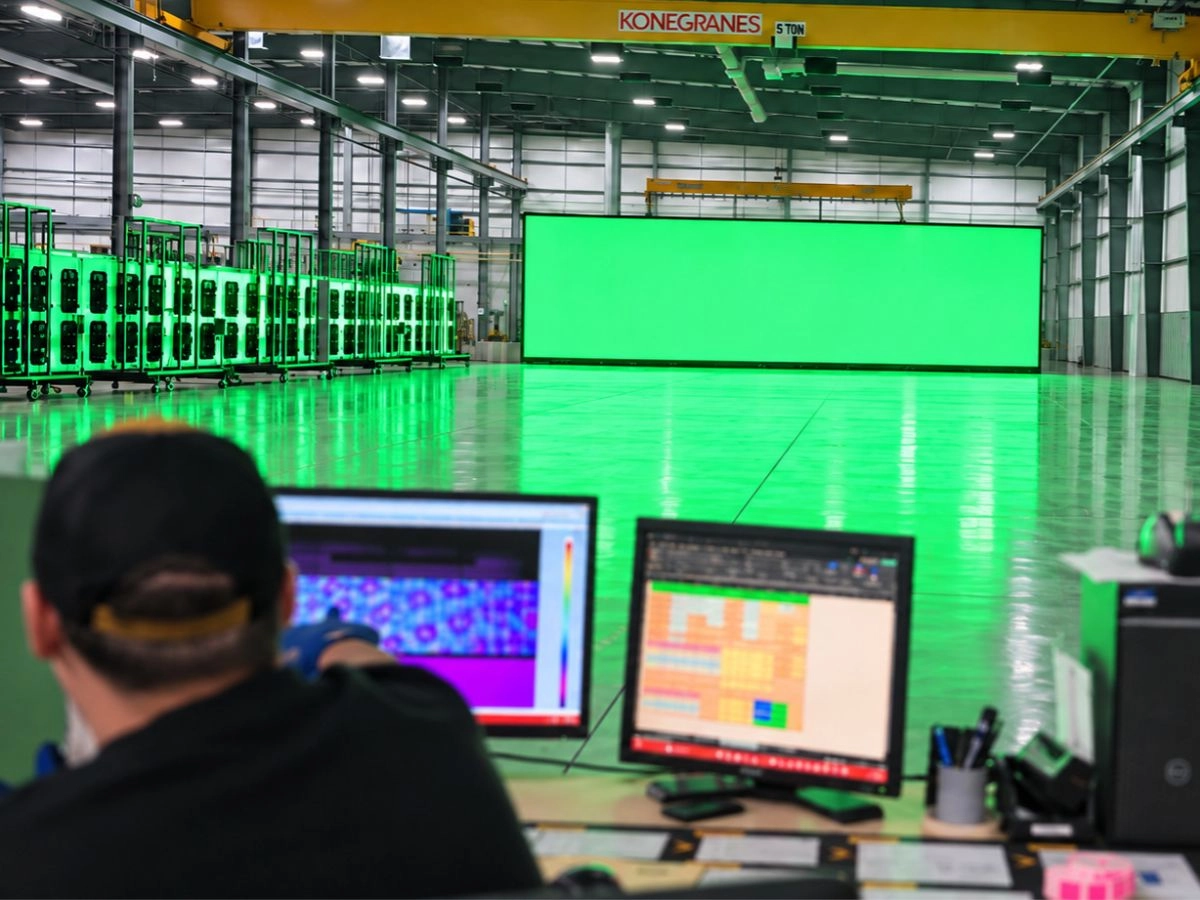
Using precision equipment, Watchfire measures every pixel and module across the fully assembled display. Technicians then fine-tune every component until color and brightness are uniform from one section to the next.
The result is a display that is 70% more uniform in color and 85% more uniform in brightness than an uncalibrated display. Instead of seeing individual panels, viewers see one cohesive image. And your brand’s signature color is replicated flawlessly, every time.
Why ColorLock isn’t duplicated?
It’s not just proprietary. The process requires a fully assembled display, along with factory space the size of a basketball court, so the equipment can measure and calculate the entire display at once. The lighting must also be tightly controlled to ensure accurate measurements. This is possible at Watchfire because we are a U.S. manufacturer that meticulously sources components from the global market and builds displays at our 120,000-square-foot factory in Danville, Illinois.
If it is a whole-display calibration, what does that mean for replacement tiles?
Whole-display calibration raises an important question: What happens if a module needs to be replaced later? ColorLock was designed with that possibility in mind.
LEDs are initially sorted into groups, known as bins, based on their color and brightness characteristics. Watchfire uses LEDs selected from a narrow quarter-bin, providing a more precise starting point for achieving a close color match. Watchfire also sets aside replacement modules from the same production run. This helps ensure that the replacement begins with LEDs that closely match those used in the original display.
Because the calibration data of every ColorLock display is kept on file, Watchfire can remotely load that data onto the replacement tile during installation, adjusting it to match the color and brightness of the surrounding tiles.
Does ColorLock still matter after a display is installed?
Yes. In fact, that’s when it matters most. LEDs naturally shift in color and brightness as they age, and no two production runs are identical. Because Watchfire keeps your display’s calibration data on file, any future repair is matched to your display’s current condition, not a factory default. That protects the uniform, professional look you paid for, not just on install day, but for the life of the display.
Watchfire engineers the best-looking, longest-lasting displays, and ColorLock protects the display for the long term. By combining whole-display factory calibration, carefully selected LEDs, lifetime calibration records, and precisely matched replacement modules, Watchfire ColorLock is quality locked in.